
Navigating the outdoors can feel confusing, especially if you have never used a compass before. Many people carry a compass for hiking, camping, orienteering, or survival. But only a few know how to use it with confidence. Learning this skill can help you stay safe, find your way, and enjoy exploring new places.
A compass is more than just a spinning needle. It is a reliable tool that works even when your phone battery dies or there is no GPS signal. With simple practice, you can use a compass to find directions, follow a map, or set a course across unknown land.
Let’s break down everything you need to know to use a compass like a pro.
Understanding The Parts Of A Compass
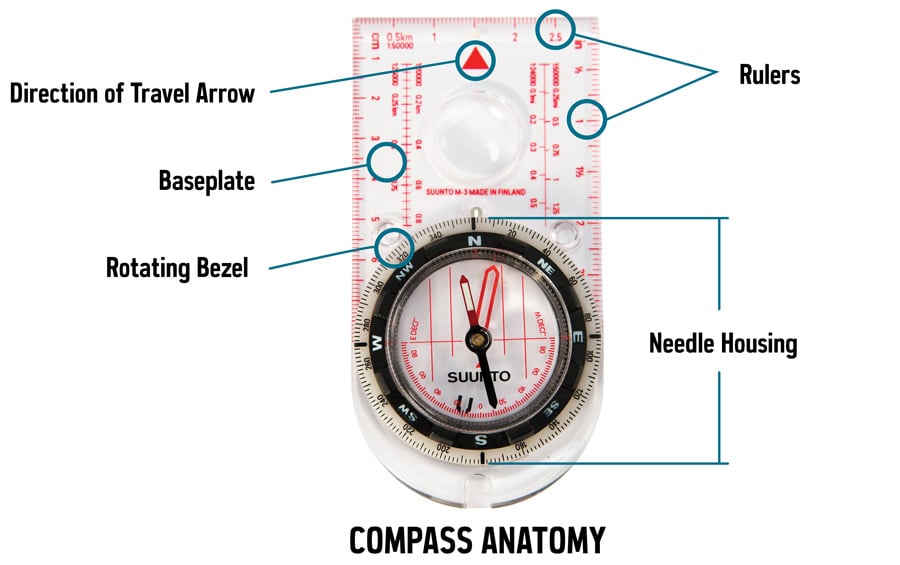
Before you start, it helps to know the basic parts of a compass. Here are the most important pieces you will see:
- Baseplate: The flat, clear piece at the bottom. It usually has rulers and a straight edge for map work.
- Compass needle: The small, thin needle that spins. The red end points to magnetic north.
- Rotating bezel: This is the circular dial with degree markings (0°–360°).
- Direction of travel arrow: The large arrow on the baseplate showing where to go.
- Orienting arrow: Inside the bezel, this marks north and helps align the compass with a map.
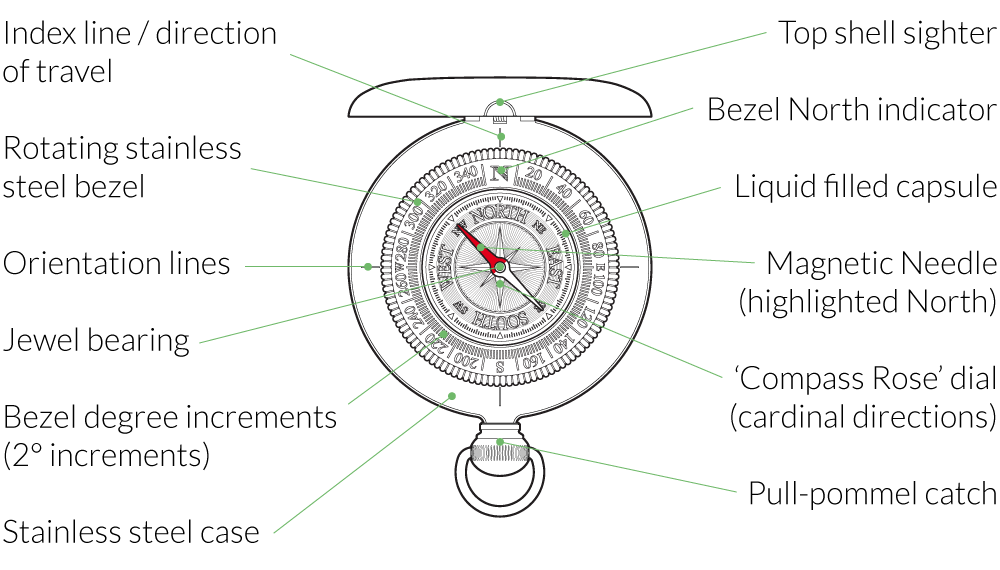
Some compasses also have mirrors, sighting lines, or clinometers, but the basic parts are enough for most users.
How A Compass Works
A compass works because of Earth’s magnetic field. The needle is magnetized and always points toward magnetic north, not true north. This is important to remember, especially when working with maps, as true north is slightly different from magnetic north. The difference is called magnetic declination.
For example, in New York City, the declination is about -13°. This means magnetic north is 13° west of true north. You can find up-to-date declination for your location at the NOAA Geomagnetic Calculator.
Credit: www.rei.com
Step-by-step: How To Use A Compass
Let’s get hands-on. Here are the main ways to use a compass:
1. Finding North
- Hold the compass flat in your hand, away from metal objects or electronics.
- Wait for the needle to stop moving.
- Turn the compass until the red (north) end lines up with the orienting arrow inside the bezel.
- The direction of travel arrow now points north.
This simple method helps you get your bearings anywhere.
2. Taking A Bearing
A bearing is a direction, measured in degrees, from your current spot.
- Point the direction of travel arrow at your target (a tree, hill, or landmark).
- Hold the compass steady and rotate the bezel until the red needle fits inside the orienting arrow.
- Read the number at the index line. This is your bearing.
For example, if you read 120°, you should walk southeast.
3. Following A Bearing
To follow a bearing:
- Set the desired bearing on the bezel.
- Hold the compass flat and turn your body until the red needle is inside the orienting arrow.
- The direction of travel arrow now points where you need to go. Walk in that direction, keeping the needle aligned.
4. Using A Compass With A Map
Combining a compass with a map gives you more control and accuracy.
- Place the compass on the map with the edge connecting your current location to your destination.
- Rotate the bezel so that “N” points to the top of the map.
- Hold the compass and map together, then turn your body until the needle lines up with the orienting arrow.
- The direction of travel arrow shows your path on the ground.
5. Adjusting For Declination
If you are in an area with strong declination, adjust your compass:
- If declination is east (positive), subtract it from your bearing.
- If declination is west (negative), add it to your bearing.
Some compasses have a small screw to set declination. If not, adjust manually before you start walking.
Common Mistakes And How To Avoid Them
Many beginners make small errors that can lead to big problems. Here are a few to watch out for:
- Holding the compass near metal: Items like keys, zippers, or even cell phones can affect the needle.
- Forgetting declination: Not adjusting for local declination can put you miles off course.
- Not leveling the compass: The needle can stick if the compass is tilted.
- Reading the wrong end of the needle: Always follow the north (red) end, not the south.
- Mixing up map and ground directions: Make sure the map is oriented correctly before matching it to the compass.
Comparing Compass Types
There are several styles of compasses. Here’s how the most common ones compare:
| Type | Best For | Pros | Cons |
|---|---|---|---|
| Baseplate | Hiking, Map Work | Easy to use, Good for maps | Can break if dropped |
| Lensatic | Military, Precision | Very accurate, Durable | Heavier, More complex |
| Button | Emergency Kits | Very small, Cheap | Not accurate, Hard to use |
Practical Tips For Using A Compass
Here are extra tips that can help you become more skilled:
- Practice at home or in a local park before heading into the wilderness.
- Always carry a paper map as backup. Compasses work best with maps.
- Mark your starting point and check your direction often.
- In thick forests, pick a close landmark on your path, walk to it, and repeat.
- If you get lost, stop and check both compass and map before moving further.
- Remember, the compass needle points to magnetic north, not where the sun rises.
Credit: www.dalvey.com
Real-life Example: Orienteering
Orienteering is a sport where you use a map and compass to find checkpoints. Speed and accuracy matter. Competitors must understand bearings, work with declination, and navigate fast. Many outdoor groups use orienteering as a fun way to teach compass skills.
Data: How Accurate Is A Compass?
Most quality compasses are accurate to within 2 degrees if used correctly. That means over 1 kilometer, your path could be off by about 35 meters. For most hikers, this is fine. For rescue or surveying, more advanced tools may be needed.

Credit: www.paddlinglight.com
Comparison: Compass Vs. Gps
Let’s see how compasses and GPS devices compare in key areas:
| Feature | Compass | GPS |
|---|---|---|
| Needs batteries | No | Yes |
| Works everywhere | Yes | No (needs satellite) |
| Easy to use | Yes, with practice | Yes, but can be complex |
| Risk of breakage | Low | Medium |
Frequently Asked Questions
How Do I Find North With A Compass?
Hold your compass flat and steady. Turn it until the red needle lines up with the orienting arrow. The direction of travel arrow now points to north.
What Is Magnetic Declination?
Magnetic declination is the angle between magnetic north (where the needle points) and true north (the top of your map). It changes depending on your location.
Can I Use A Compass Without A Map?
Yes, you can use a compass alone to find basic directions or walk in a straight line. But for precise navigation, a map is very helpful.
Why Does My Compass Needle Not Move?
This can happen if you hold the compass near metal or electronics, or if you tilt it. Move away from metal objects and keep the compass flat.
Are Smartphone Compasses Reliable?
Smartphone compasses can be useful, but they need calibration and use batteries. A real compass is more reliable in remote areas.
Mastering a compass is a skill worth having, no matter where you travel. With practice and attention to detail, you can trust your compass to guide you safely through any adventure.
