
Purifying water is a skill that touches every part of life. Clean water is not just important—it’s essential for health, safety, and survival. Whether you’re traveling, hiking, facing an emergency, or living in an area with unreliable water sources, knowing how to purify water can protect you from disease, dehydration, and even death.
This guide explains the science, methods, and practical steps to purify water, using simple language and clear examples. You’ll learn the differences between filtration and purification, discover safe techniques for home and outdoor use, and avoid common mistakes. By the end, you’ll feel confident to handle water purification in almost any situation.
Why Water Purification Matters
Water is everywhere, but safe drinking water is not. According to the World Health Organization, nearly 2 billion people use contaminated water each day. Dirty water can carry bacteria, viruses, parasites, and chemicals. Drinking it can cause diseases like cholera, dysentery, and hepatitis A. Even mild contamination can cause stomach problems, skin infections, or long-term health issues.
In emergencies—like floods, earthquakes, or power outages—public water supplies can fail. Travelers and hikers may need to drink from rivers or lakes. In these cases, purifying water is not just a convenience; it’s a life-saving skill.
Understanding Water Contaminants
Before choosing a purification method, it’s important to know what you’re trying to remove. Water can be contaminated in several ways:
- Biological contaminants: These include bacteria (like E. coli), viruses (like norovirus), and parasites (like Giardia).
- Chemical contaminants: These come from pesticides, industrial waste, heavy metals, or household chemicals.
- Physical contaminants: Dirt, sediment, and particles that make water cloudy.
Not all methods remove every type of contaminant. For example, boiling kills germs but does not remove chemicals. Filtration removes particles but may miss viruses. Understanding this helps you choose the right solution.
Filtration Vs. Purification
Many people confuse filtration and purification. They are not the same:
- Filtration: Removes particles, dirt, and sometimes bacteria. It does not kill viruses or remove chemicals.
- Purification: Removes or kills all major contaminants—biological, chemical, and physical.
In most cases, you need both. For example, filtering muddy river water removes dirt, but you must purify it afterward to kill germs.
Here is a simple comparison:
| Method | Removes Particles | Kills Bacteria | Kills Viruses | Removes Chemicals |
|---|---|---|---|---|
| Filtration | Yes | Sometimes | No | Rarely |
| Boiling | No | Yes | Yes | No |
| Chemical Treatment | No | Yes | Yes | No |
| Reverse Osmosis | Yes | Yes | Yes | Yes |
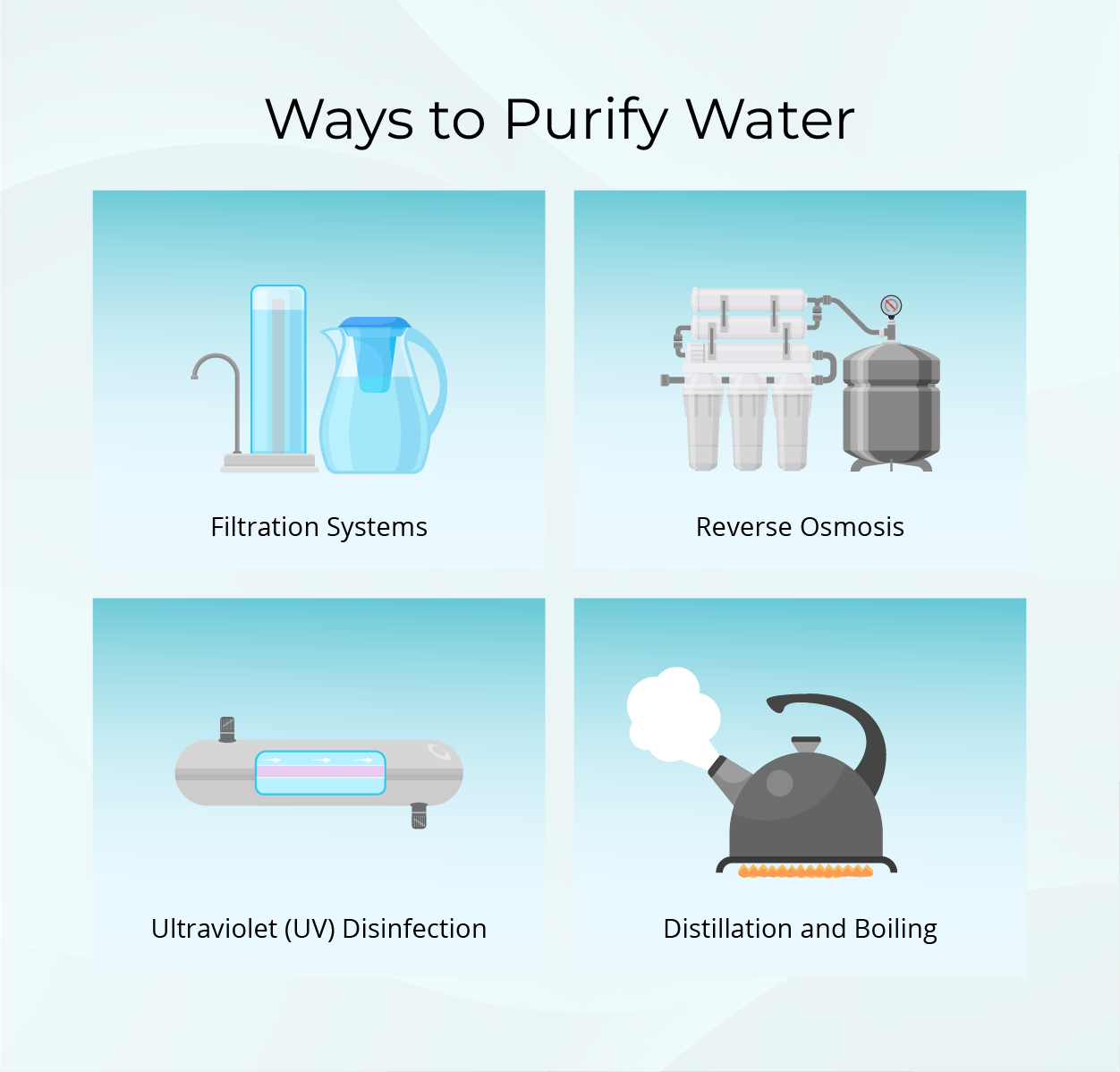
Common Water Purification Methods
There are many ways to purify water. Some are simple, others require special equipment. Here are the most reliable methods:
Boiling
Boiling is the oldest and simplest method. It kills bacteria, viruses, and parasites by heat.
How to do it:
- Filter out large particles (if water is cloudy).
- Heat water until it reaches a rolling boil.
- Keep boiling for at least 1 minute (3 minutes at high altitudes).
- Let it cool before drinking.
Advantages:
- Effective against biological contaminants.
- No chemicals needed.
Limitations:
- Does not remove chemicals or heavy metals.
- Requires fuel and a container.
Example: After a flood, boil tap water before drinking.
Chemical Disinfection
Chemicals like chlorine, iodine, and chlorine dioxide can kill germs.
How to do it:
- Filter out dirt and particles.
- Add the correct amount of chemical (read package instructions).
- Stir and wait—usually 30 minutes.
Advantages:
- Portable, easy for hiking and travel.
- Kills most bacteria and viruses.
Limitations:
- Some chemicals leave taste or odor.
- Not effective against some parasites (e.g., Cryptosporidium).
- Does not remove chemicals or particles.
Example: Use iodine tablets when camping.
Filtration
Water filters use physical barriers (like membranes or carbon) to trap contaminants.
Types of filters:
- Ceramic filters: Good for bacteria and particles.
- Activated carbon filters: Remove chemicals and improve taste.
- Membrane filters: Trap particles, bacteria, some viruses.
How to use:
- Pour water through the filter.
- Collect clean water in a container.
Advantages:
- Fast and easy.
- Removes particles and many bacteria.
Limitations:
- Most do not remove viruses.
- Need regular cleaning or replacement.
Example: Use a portable filter for stream water.
Ultraviolet (uv) Treatment
UV light kills bacteria, viruses, and parasites by damaging their DNA.
How to do it:
- Filter water if cloudy.
- Use a UV device (like a SteriPen).
- Stir device in water for the recommended time.
Advantages:
- Fast, no chemicals.
- Portable.
Limitations:
- Requires batteries/electricity.
- Does not remove chemicals or particles.
Example: Treat hotel tap water with UV if unsure about safety.
Reverse Osmosis
This advanced method forces water through a membrane that blocks almost all contaminants.
How to do it:
- Connect system to water supply.
- Water passes through membrane.
- Clean water collects in storage tank.
Advantages:
- Removes nearly all contaminants—biological, chemical, physical.
- Used in homes and for emergency desalination.
Limitations:
- Expensive, needs installation.
- Slow process.
Example: Use at home for well water purification.
Distillation
Distillation boils water and collects the steam, leaving contaminants behind.
How to do it:
- Heat water in a still.
- Steam rises, cools, and condenses into clean water.
Advantages:
- Removes bacteria, viruses, chemicals, heavy metals.
Limitations:
- Slow process.
- Requires energy and equipment.
Example: Emergency distillation kits for disaster relief.
Solar Purification (sodis)
Sunlight can kill germs in water using UV rays.
How to do it:
- Fill clear plastic bottles with water.
- Place in direct sunlight for 6 hours (or 2 days if cloudy).
- Drink after cooling.
Advantages:
- No chemicals or fuel.
- Low-cost.
Limitations:
- Only works with clear water.
- Slow, not effective against chemicals.
Example: Used in rural areas in Africa and Asia.
Choosing The Best Method
Not every method fits every situation. Here’s how to choose:
Home Use
For home water, safety matters most. If your supply is unreliable:
- Use reverse osmosis or distillation for best results.
- Combine carbon filtration with UV for extra protection.
- Boiling is useful for emergencies.
Outdoor And Travel
When hiking or traveling:
- Carry portable filters and chemical tablets.
- Boil water if possible.
- UV devices are light and easy for short trips.
Emergency Situations
During disasters:
- Boil water whenever possible.
- Use chemical disinfection if fuel is limited.
- Solar purification can help if no equipment is available.
Comparing Methods
Here’s a quick comparison of three popular methods for field use:
| Method | Speed | Effectiveness | Cost | Portability |
|---|---|---|---|---|
| Boiling | Slow (minutes) | High (biological only) | Low | Medium |
| Chemical Tablets | Medium (30 mins) | High (biological) | Low | High |
| Portable Filter | Fast (seconds) | Medium (not viruses) | Medium | High |
Step-by-step Water Purification Process
Purifying water is not just about using a device or tablet. It’s a process. Follow these steps for maximum safety:
1. Assess The Water Source
Look at the water. Is it clear or muddy? Does it smell strange? Are animals nearby? If possible, choose the cleanest source—upstream from human or animal activity.
2. Pre-filter Large Particles
If water is cloudy, filter out dirt and debris first. Use a cloth, coffee filter, or simple paper towel.
3. Choose Your Purification Method
Pick the best method for your situation. If you have several tools, combine them—like filtering before boiling.
4. Purify
Follow instructions for your chosen method:
- Boil for at least 1 minute.
- Add chemicals as directed.
- Use UV device for the right amount of time.
5. Store Safely
Keep purified water in clean, sealed containers. Don’t reuse bottles that held dirty water.
6. Avoid Recontamination
Wash hands before handling clean water. Don’t dip dirty cups or hands into purified water. If possible, label containers as “clean. ”
Practical Tips For Safe Water Purification
Many beginners overlook small details that can make water unsafe. Here are some non-obvious tips:
- Always pre-filter cloudy water. Even the best purifiers work better with clear water.
- Don’t rely on taste. Water can look and taste fine but still carry invisible germs or chemicals.
- Keep purification tools clean. Dirty filters or bottles can recontaminate water.
- Check chemical expiry dates. Old tablets may not work well.
- Altitude affects boiling. Water boils at lower temperatures above 6,500 feet (2,000 meters), so boil longer.
- Use two methods if unsure. For example, filter first, then use UV or chemicals.
- Store water away from sunlight. Sunlight can cause algae to grow in stored water.
Water Purification For Kids, Elderly, And Vulnerable People
Some groups need extra care. Young children, elderly, pregnant women, and people with weak immune systems are more sensitive to waterborne diseases.
- Use the most reliable method available.
- Avoid chemical treatments if someone has allergies or thyroid problems.
- Always boil water for babies’ formula.
- If in doubt, use reverse osmosis or distillation.
Advanced Water Purification Technologies
In recent years, technology has improved water purification. Here are a few advanced methods:
Nanofiltration
Nanofiltration uses membranes with tiny pores to remove bacteria, viruses, and some chemicals. It’s more efficient than regular filters and uses less energy than reverse osmosis.
Electrolytic Purification
This method uses electricity to kill germs. It’s fast and can be built into portable devices. However, it requires a power source.
Ozone Treatment
Ozone is a powerful disinfectant. Some water systems use ozone gas to kill bacteria and viruses. It’s used in cities and commercial bottling.
Smart Purifiers
Modern purifiers have sensors to test water quality and automatic cleaning. Some connect to smartphones for monitoring.
These technologies are often expensive but offer extra safety for homes and businesses.
Safe Water Storage
Purifying water is only half the battle. Clean water can become dirty if stored incorrectly.
Tips For Safe Storage
- Use food-grade containers (not just any plastic bottle).
- Clean containers with soap and water before use.
- Store water in cool, dark places.
- If storing for more than a week, re-purify before drinking.
Data point: The CDC recommends storing at least 1 gallon (3.8 liters) per person per day for emergencies.

Credit: www.wikihow.com
Mistakes To Avoid In Water Purification
Even experienced people make mistakes. Here are some to watch out for:
- Skipping pre-filtration: Mud or dirt can block filters or reduce effectiveness.
- Using old chemicals: Expired tablets may not kill germs.
- Not boiling long enough: In high-altitude areas, water needs more time.
- Reusing dirty bottles: Can reintroduce bacteria.
- Ignoring chemical contamination: Boiling does not remove chemicals.
- Assuming all filters remove viruses: Most don’t.
Real-world Examples
Urban Example
After Hurricane Katrina, many residents had to boil water due to broken pipes. Some used bleach (unscented, 2 drops per liter) to disinfect water.
Hiking Example
A hiker in the Rockies filtered stream water, then used chlorine dioxide tablets. He avoided sickness, while others who skipped tablets got stomach infections.
Developing Country Example
In Bangladesh, families use ceramic filters and SODIS to treat pond water. UNICEF reports a drop in diarrhea cases where these methods are used.
Credit: longsecowater.com
Comparing Water Purification For Different Needs
Not every method suits every need. Here’s a table comparing home, travel, and emergency situations:
| Need | Best Method | Cost | Ease of Use | Effectiveness |
|---|---|---|---|---|
| Home | Reverse Osmosis | High | Medium | Very High |
| Travel | Portable Filter + Chemical Tablets | Medium | High | High |
| Emergency | Boiling / SODIS | Low | Medium | High (biological only) |
The Science Behind Purification
It helps to understand how purification works:
- Boiling: Heat kills germs by breaking their cell walls.
- Chemicals: Chlorine and iodine disrupt germs’ DNA.
- Filtration: Filters use tiny pores to trap contaminants.
- UV: UV light destroys germs’ genetic material.
- Reverse Osmosis: Water molecules pass through, but contaminants are blocked.
Knowing the science can help you troubleshoot problems. For example, if water remains cloudy after filtration, the filter may be clogged.
Water Purification In Extreme Conditions
Sometimes, you may face extreme conditions—dirty floodwater, salty seawater, or no equipment. Here’s what to do:
Floodwater
Floods mix sewage, chemicals, and debris. Always use multiple methods:
- Filter first.
- Boil.
- Use chemical treatment if possible.
Seawater
Salt cannot be removed by boiling or regular filters. Use distillation or reverse osmosis only.
No Equipment
If you have nothing, let water settle. Pour off clear water. Use sunlight (SODIS) if possible. Even basic steps are better than nothing.
Legal And Health Guidelines
Different countries set standards for water safety. In the US, the EPA regulates tap water. In emergencies, local health departments may advise boiling or chemical treatment. Always follow official advice.
For more technical information, visit the CDC’s water safety page.
Credit: www.frizzlife.com
Frequently Asked Questions
How Long Should I Boil Water To Make It Safe?
You should boil water for at least 1 minute at sea level and 3 minutes at high altitudes. This kills most bacteria, viruses, and parasites.
Can I Use Bleach To Purify Water?
Yes, unscented household bleach can be used. Add 2 drops per liter (quart), stir, and wait 30 minutes. Never use scented or colored bleach.
Do Water Filters Remove Viruses?
Most portable filters do not remove viruses. Only advanced filters (like reverse osmosis or special virus-rated filters) can do this.
How Long Can I Store Purified Water?
Store water in clean, sealed containers for up to 6 months. If unsure, re-purify before drinking.
What If Water Tastes Strange After Purification?
Chemical treatments can cause taste or odor changes. This is normal but not harmful. If water tastes metallic or strongly chemical, use a carbon filter to improve taste.
Clean water is a basic need, but in many places, it’s not guaranteed. By learning how to purify water, you protect yourself and others from sickness and danger. Every method has strengths and weaknesses, so choose carefully based on your situation.
Use more than one method for extra safety, and always store water properly. With the right knowledge and tools, you can turn almost any water source into safe drinking water.
